






















From the 1990s, face recognition technology (FRT) has moved well beyond experimentation. Today, it underpins digital identity systems, payments, transport, and public services across the globe.
Yet adoption is far from uniform: different countries are moving at different speeds, shaped not just by technology, but by regulation, infrastructure, and political priorities.
Yet adoption is far from uniform: different countries are moving at different speeds, shaped not just by technology, but by regulation, infrastructure, and political priorities.
Face Recognition Market Maturity Stages
Every technology market—including face biometrics—tends to evolve through six recognizable stages:
- Emergence – research, early prototypes, and pilots
- Early Growth – initial commercial deployments and experimentation
- Standardization – development of technical standards and interoperability
- Regulation – legal frameworks, ethical guidelines, and compliance requirements
- Integration – embedding the technology into large-scale platforms, both public and private
- Consolidation – market leaders dominate, and the technology becomes core infrastructure
Mapping FRT adoption across regions shows a multi-speed global market: some countries have reached consolidation and platformization, while others are still in early growth or standardization phases.
Understanding each region’s position along this six-stage lifecycle helps explain not only the pace of adoption but also the key drivers, risks, and opportunities for investors, developers, and policymakers.
Understanding each region’s position along this six-stage lifecycle helps explain not only the pace of adoption but also the key drivers, risks, and opportunities for investors, developers, and policymakers.
Below is a regional breakdown of where face recognition stands today—and what is driving or limiting its next phase.
Face Recognition Market Maturity by Region
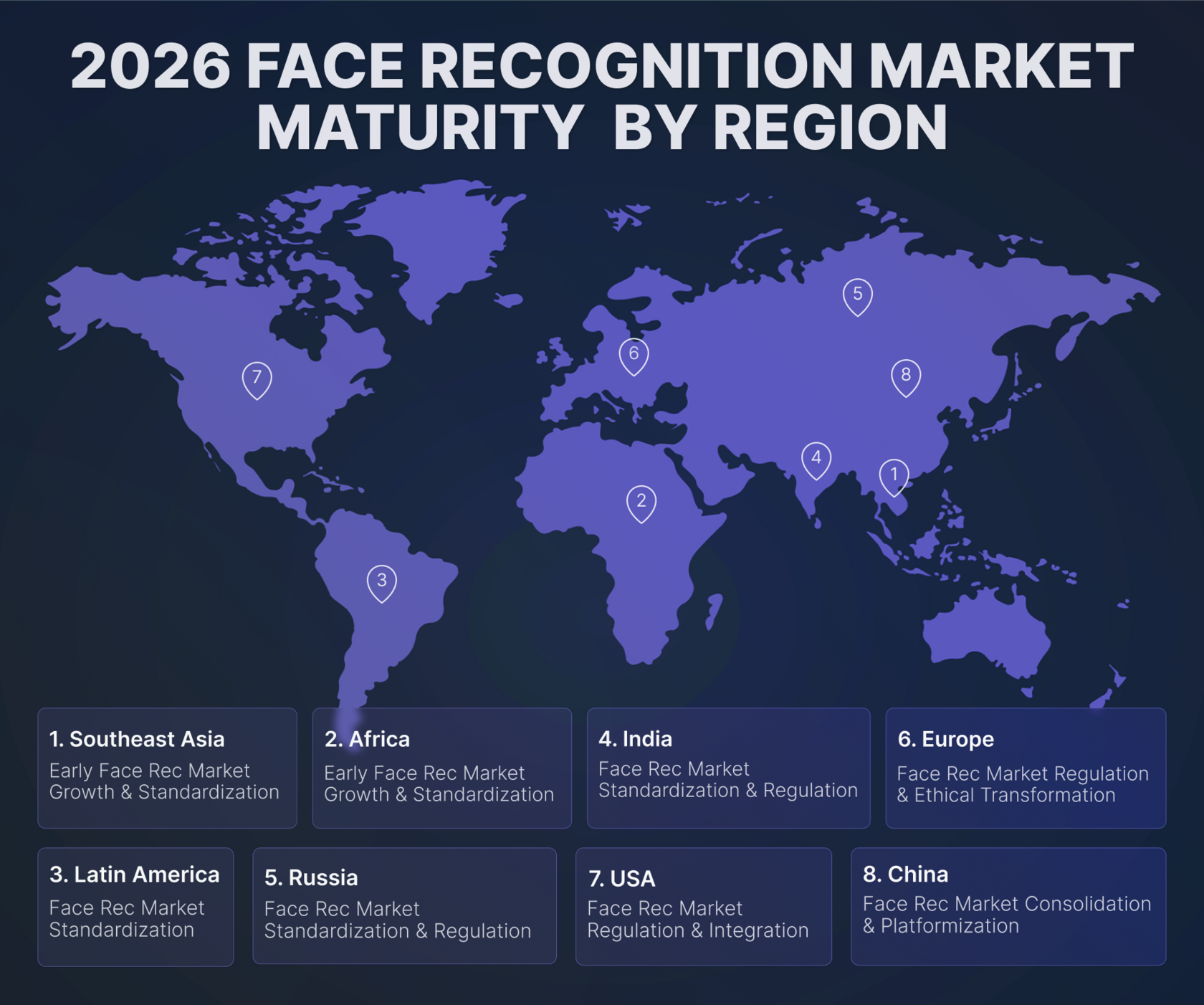
Southeast Asia and Africa: Fast Starts, Fragile Foundations (Stage 1–3)
Across Southeast Asia and Africa, governments are rolling out national eID programs at speed. Systems like Nigeria’s NIN, Kenya’s Huduma, and Indonesia’s eKTP are often built with external funding, MOSIP-based architectures, and international partnerships.
The market favors white-label, royalty-free, and MOSIP-compatible solutions. But dependence on foreign technology providers and weak local infrastructure remain structural risks.
Key dynamics: ambition is high, resilience is not yet proven.
Latin America: Momentum Without Muscle (Stage 3)
Latin America is seeing growing adoption of face recognition in banking, transport, and social programs, supported by data protection frameworks like Brazil’s LGPD and expanding digital government initiatives.
However, limited infrastructure, lack of skilled personnel, and inconsistent execution slow the transition from pilots to platforms. Startups are active but constrained by deployment realities.
Key dynamics: strong demand signal, weak execution layer.
India and Russia: State-Led Identity at Different Speeds (Stage 3–4)
India and Russia share a common pattern: face recognition adoption is driven primarily by government infrastructure rather than private platforms.
In India, Aadhaar 2.0 and MOSIP underpin one of the world’s largest digital identity systems, creating a foundation for financial inclusion and public service delivery. Private-sector adoption is emerging, but operational consistency and data security remain uneven.
In Russia, deployment spans transport, housing and utilities, healthcare, education, and public safety, anchored by initiatives such as “Safe City” and the Unified Biometric System (EBS). Domestic standards and import substitution policies are reshaping the ecosystem, though fragmentation across agencies persists.
Key dynamics: strong state momentum, uneven commercial maturity.
Europe: Ethics First, Scale Second (Stage 4)
Europe’s face recognition market is defined by regulation rather than velocity. Public-space use is heavily restricted, and the focus has shifted toward privacy-preserving design, explainable AI (XAI), and formal certification under the EU AI Act.
Standards bodies like ISO and CEN-CENELEC play a central role, particularly for vendors targeting cross-border deployments. While this creates a high bar for quality and accountability, it also fragments the market and slows large-scale rollouts.
Europe is less about “who deploys fastest” and more about “who survives compliance.”
Key dynamics: high trust, high standards—limited scale.
United States: Innovation Under Scrutiny (Stage 4–5)
In the U.S., face recognition is largely private-sector driven. Major players like Apple, Amazon, and Clearview AI operate in an environment defined by litigation, public debate, and regulatory ambiguity. Adoption is strongest in banking, eKYC, retail, and enterprise security.
The market is being shaped by soft-law mechanisms rather than centralized regulation: court rulings, the AI Bill of Rights, corporate ethics frameworks, and state-level legislation. This creates room for innovation—but also friction.
Public distrust remains a real constraint. High-profile bans, moratoriums, and lawsuits mean that deployment often advances quietly, behind UX layers or as part of broader identity workflows.
Key dynamics: strong commercial demand, but growth is gated by trust and legal exposure.
China: Platformization at National Scale (Stage 6)
China represents the most mature face recognition market globally. The technology is deeply embedded across transport systems, government services, commerce, education, and smart city infrastructure. Face ID isn’t a feature—it’s a layer.
This scale is driven by sustained state investment, unified GB/T technical standards, and tight integration with national platforms, including elements linked to social credit systems. From an execution standpoint, China has solved what many regions still struggle with: interoperability and mass deployment.
The risk, however, is structural. Concerns around excessive state control, limited transparency, privacy erosion, and geopolitical sanctions increasingly shape how Chinese FRT platforms are perceived—and where they can expand.
Key dynamics: unmatched scale and integration, offset by global trust and compliance barriers.
For investors, developers, and integrators, regional dynamics are critical: adoption speed, regulatory frameworks, and infrastructure readiness vary widely, and ignoring these differences is a strategic risk.
In 2026 understanding where each market sits in the FRT lifecycle is essential for integrating and using facial recognition solutions effectively.
In 2026 understanding where each market sits in the FRT lifecycle is essential for integrating and using facial recognition solutions effectively.