
























Netflix turns AI into a thriller plot. In reality, the technology isn’t that simple — or that dangerous.
Spoilers ahead!
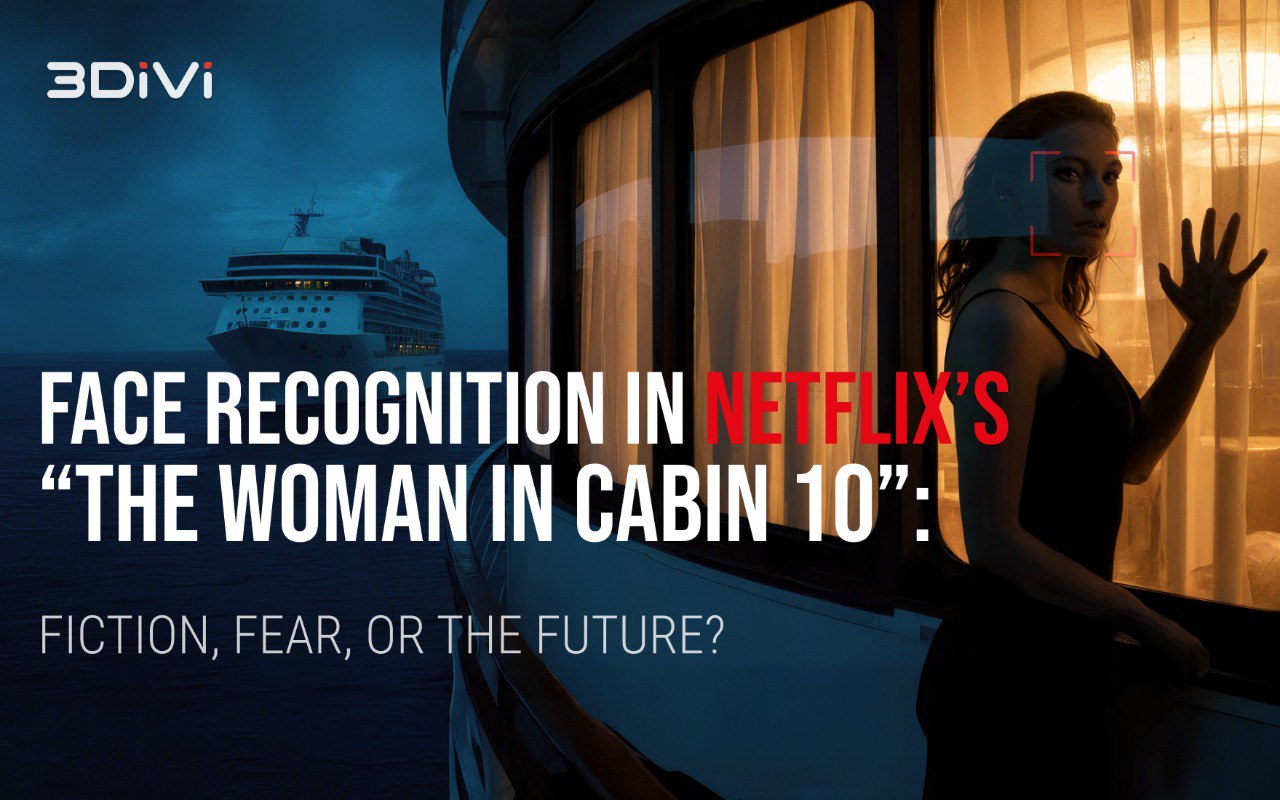
Netflix’s The Woman in Cabin 10 shows facial recognition as a high-stakes weapon. A villain husband uses AI to find a woman who resembles his deceased wife — and manipulates her into impersonating her during a notary signing to seize property.
It’s a gripping story built on real technology. But how much of it could actually happen outside a movie script? The answer sits somewhere between “partly possible” and “movie magic.”
The tech behind the fiction
The film dramatizes a one-to-many (1:N) face search —scanning a social platform to find visually similar faces. Modern facial recognition systems can indeed be highly (99+%) accurate in ideal lab conditions: good lighting, frontal poses, and high-resolution photos.
Reality is much messier. Accuracy declines when faces are angled, occluded, or altered by makeup, masks, or glasses. Even small lighting changes can distort results.
Lowering the similarity threshold (say, accepting matches above 85%) expands results but also floods them with false positives — a tradeoff every real-world system must balance.
Lowering the similarity threshold (say, accepting matches above 85%) expands results but also floods them with false positives — a tradeoff every real-world system must balance.
So while the villain’s search looks effortless on screen, in practice, it’s rarely so clean.
The attacker’s toolkit
Public reverse-image search engines like PimEyes or Reversely can identify look-alikes from open-web photos, but social platforms are a different story. API limits, login walls, and bot-detection systems make scraping user data at scale technically difficult and legally risky.
In the movie, the villain bypasses all that by leveraging a guest who conveniently built a social media platform — granting him unrestricted database access.
It’s a classic cinematic shortcut. In the real world, it would trigger legal red flags and multiple cybersecurity alerts long before results loaded.
It’s a classic cinematic shortcut. In the real world, it would trigger legal red flags and multiple cybersecurity alerts long before results loaded.
Where the real risk lies: human verification
The film’s notary scene reveals a bigger truth about identity verification — the weakest point isn’t the technology but the process around it. Relying on a passport and witnesses alone creates a window for social engineering and impersonation.
Modern notarial and e-signing systems can counter this with multi-factor authentication (face match + fingerprint, voice, or PIN verification) and risk-based workflows that scale scrutiny with transaction value.
The smarter approach is adaptive security that balances friction and fraud prevention.
The movie vs. reality
Could facial recognition enable this kind of fraud? Technically, yes — but only under a perfect storm of favorable conditions: access to proprietary databases, insider privilege, and poor verification controls.
As cybersecurity leader Matthew Webster puts it:
“Risk is the possibility that an event or condition will impact objectives.”
Here, the objective = secure identity verification — and the movie simply dramatizes the rare chain of conditions that could compromise it.
In reality, identity fraud isn’t cinematic drama — it’s a daily business threat.
In reality, identity fraud isn’t cinematic drama — it’s a daily business threat.
That’s why modern anti-fraud systems must be reliable, scalable, and smart.
✨ Learn how 3DiVi face biometrics make that possible✨
✨ Learn how 3DiVi face biometrics make that possible✨