
























Written by: Mikhaylo Pavlyuk, Digital Identity Consultant
I was out on a walk, listening to a fantasy audiobook, when one line made me pause:
"Hope is a fickle and dangerous thing. It steals focus, pulling us toward possibilities instead of keeping us grounded in probabilities."
In biometric identity verification, this distinction is not philosophical — it is operational. It defines how C-level and risk leaders should evaluate system trust, performance, and fraud exposure. Here's why.
Download the White Paper: Threat Model for Remote Biometric Identification
Hope vs Prudence in Biometric Authentication
In facial biometrics, it’s easy to fall into the trap of “hope.”
A face is detected. Liveness checks are in place. Anti-spoofing and session-level anti-fraud are running. On paper, the system looks capable of mitigating risk.
But once you go live—different devices, varying camera quality, unstable networks, evolving attack patterns—those possibilities no longer answer the key question:
What is the probability of failure, and how does it change over time?
This is why possibilities can be dangerous—they steal focus.
We end up talking about what a system can do, rather than how much it can be trusted in the real world.
Take a few examples:
- “We have liveness detection”—but what percent of attempts does it catch? Where does it fail? On which devices does it degrade?
- “We have anti-fraud”—does it actually reduce losses, or just add noise to alerts?
- “Our face-matching is powerful”—but how does accuracy hold up in poor lighting, low-resolution cameras, or compressed video?
Without metrics, all you’re left with is hope.
Performance Metrics: The Key to Measuring Probability
In biometric identity verification systems, the real challenge isn’t what the technology can do—it’s understanding how well it actually performs in the real world. That’s where performance metrics make the difference.
Take our biometric identity verification platform 3DiVi BAF as an example. It combines three core layers:
- Face biometrics — verification and identification
- Protection against biometric attacks — liveness and deepfake detection
- Session-level anti-fraud — behavioral and environmental signals
Then it adds a fourth layer: performance metrics, which measure outcomes and risks in real-world conditions.
These metrics are aligned with NIST SP 800-63-4 Digital Identity Guidelines, not just for compliance, but to make the system manageable. It turns the conversation from “we have features” to “here’s what works, where, and with what likelihood of success or failure.”
Some of the key metrics include:
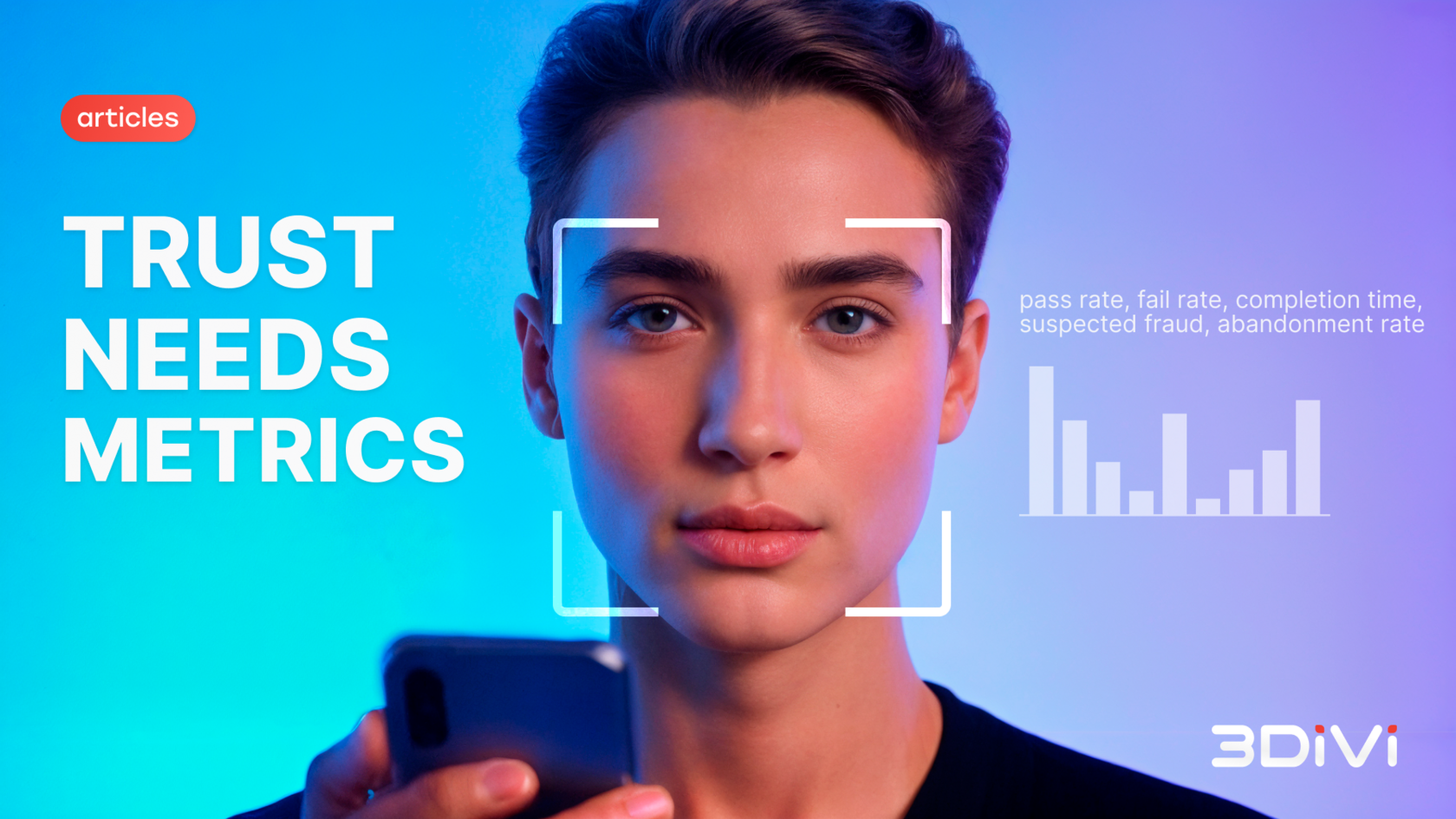
- passRate/failRate — share of successful vs. failed attempts
- completion time — how long it takes users to complete authentication
- suspectedFraud — percentage of attempts flagged as risky
- abandonmentRate — share of users who drop off
- fraudProofing/fraudAuthentication — fraud observed at different stages
- authenticationFailures — average failed attempts per user
These aren’t just “magic KPIs.” They form a real-time 3DiVi BAF's dashboard that highlights where the funnel dips, where risk grows, and how attack patterns evolve—all expressed as probabilities.
Armed with this data, teams can make informed decisions on thresholds, controls, and trade-offs—rather than guessing or relying on what the system might do in theory.
4 Steps to Turn Metrics Into Prudence
1. Stop arguing over “like/dislike” and start calibrating.
Metrics let you tune thresholds and rules—not based on intuition, but on observed outcomes. Are you reducing losses without killing conversion? Metrics let you know.
2. Track drift in quality and threats.
A rising abandonment rate? Could be UX, devices, or network problems. A rising suspected fraud rate? Could be an attack pattern / audience change. Without metrics, this looks like chaos. With metrics, it’s a manageable signal.
3. Session-level anti-fraud adds “probability context.”
Biometrics answers: “Does this face match?”
Session signals answer “How much can I trust this attempt right now?”
Metrics show how this context affects real outcomes.
4. Enable honest conversations with the business.
Not: “We’re protected.”
But: “At these thresholds and across these channels, here are the probabilities of errors—and the trade-offs between false rejects and false accepts.”
Hope always paints a beautiful picture of possibilities.
Prudence requires boring probability math—but it’s the math that keeps your system grounded in reality: in traffic, on old devices, under new attacks, in conditions you cannot fully control.
Build secure digital identity with 3DiVi BAF — biometric identity verification platform for banks, fintechs, and government services.
➟ Explore 3DiVi BAF